Capital Mobilisation to Transition Enablement: How SET is Turning Climate Ambition into Action
The Climate Transition Challenge
Thailand faces significant physical climate risks, with potential economic losses reaching 40% of GDP over the next 20–30 years without effective adaptation¹. Meanwhile, the transition to a low-carbon economy and the growth of green industries could generate additional economic growth of 5–10% above the baseline².
Realising this potential requires more than capital. Many businesses still lack the reliable data, technical capabilities and credible transition plans needed to turn climate ambitions into bankable projects. The climate finance gap is therefore not simply a funding issue, but a gap between available capital and the bankable projects needed to deliver meaningful transition outcomes. Closing this gap requires a capital market ecosystem that connects reliable data, business action, technology and financing.
To support Thai businesses’ transition, the Stock Exchange of Thailand (SET) is expanding its role beyond providing a platform for capital raising to become a “Transition Enabler”. It leverages its capital market infrastructure, partnerships and sustainability initiatives to help listed companies understand climate-related risks, strengthen their capabilities and translate transition objectives into action.
Building the Foundation: From Climate Data to Action
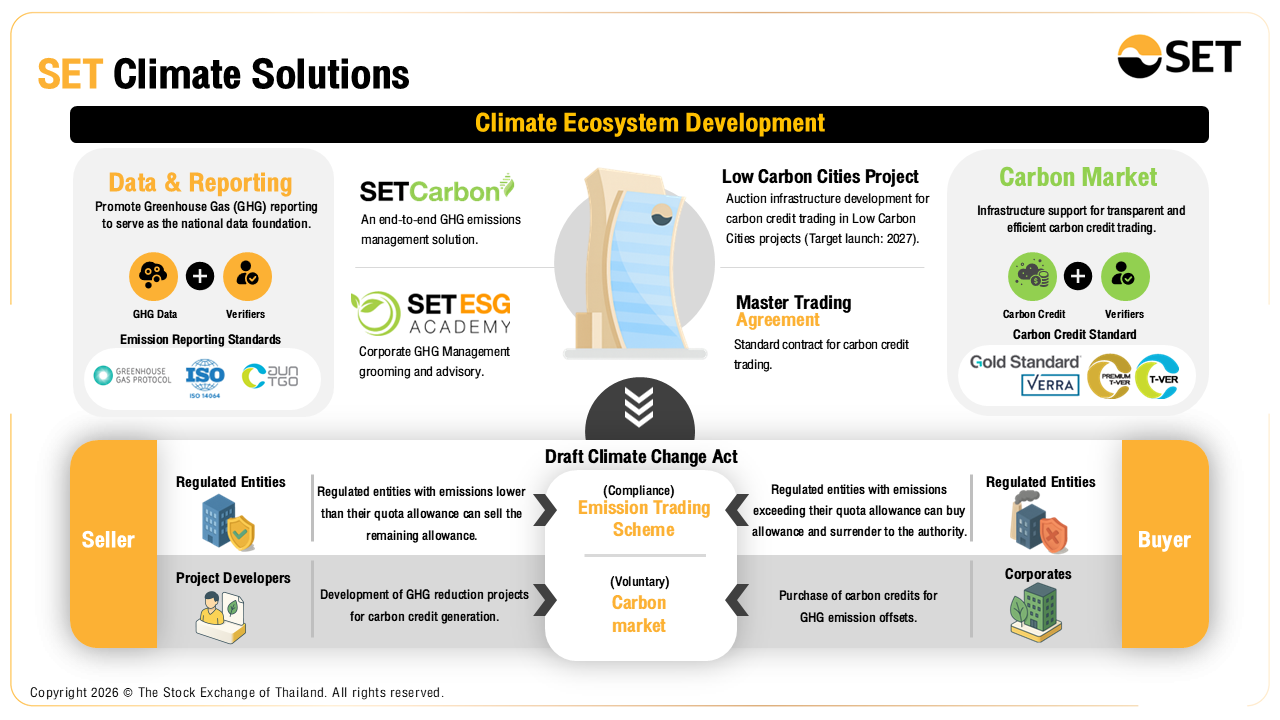
A credible transition starts with reliable data. Without a clear understanding of their emissions and climate-related impacts, businesses cannot identify priorities, assess risks or develop effective transition plans. Therefore, SET has focused on strengthening both corporate capabilities and the underlying data infrastructure.
Through “SET ESG Academy”, companies can develop the knowledge and skills needed to measure greenhouse gas emissions, assess climate impacts and improve sustainability disclosures in line with international standards. The emphasis is on a science-based approach, ensuring that climate action is supported by sound methodologies rather than broad commitments alone.
Complementing this capacity-building effort, SET has developed “SETCarbon”, a platform designed to support corporate greenhouse gas (GHG) accounting and emissions data management. The platform provides companies with the tools to calculate and manage their emissions, while reducing the time and costs associated with fragmented data collection and repetitive reporting.
The value of this infrastructure extends beyond reporting. Quality data provides the basis for better business decisions, allowing companies to identify emissions hotspots, assess operational risks and prioritise areas for improvement.
Importantly, climate transition cannot be achieved by individual companies acting alone. Emissions across supply chains often represent a significant part of a company's overall footprint. SETCarbon therefore aims to support wider participation across the value chain, helping listed companies engage suppliers and business partners in measuring and managing emissions.
Turning Data into Investment Opportunities
Moving from climate commitments to implementation requires more than setting emissions reduction targets. Companies also need practical transition pathways, access to suitable technologies and financing that reflects their business needs. To support this next stage, SET is planning to develop two additional functions under SETCarbon, namely “Decarbonisation Enablers” to facilitate emissions reduction planning and “Business and Financial Solutions” to connect businesses with technology providers and financial institutions.
Together, these two functions are designed to connect transition planning with implementation. More structured and reliable corporate data will also provide financial institutions with a stronger basis for assessing financing needs and developing solutions that respond to businesses' transition requirements. This will make relevant technologies and financing more accessible, while supporting measurable progress across companies and their supply chains.
Carbon Markets: Supporting Transition through Market Mechanisms
SET recognises that investments in decarbonisation often take time to implement, while companies may face nearer-term climate commitments. Carbon pricing mechanisms can play a complementary role by putting a price on emissions, creating economic incentives for businesses to invest in lower-carbon technologies and supporting the mobilisation of climate finance.
To support this market mechanism, SET has been developing a Carbon Trading Platform that creates opportunities for companies that have reduced their emissions and generated surplus carbon credits to sell them to businesses that need credits to offset their carbon footprints. Carbon credits should serve only as a complementary measure of last resort, not as a substitute for direct emissions reduction or a means of delaying climate action.
As a pilot project, SET has developed an auction platform for carbon credits from the Low Carbon Cities and Carbon Market Development Project, in collaboration with the World Bank, the Department of Climate Change, the Bangkok Metropolitan Administration and financial institutions. The project aims to generate practical insights and lessons that can inform the future development of Thailand's mandatory carbon market.
Looking ahead, SET is developing the infrastructure for a mandatory carbon market through an Emissions Trading Scheme (ETS) under Thailand's Climate Change Act, which is currently under legislative consideration. These efforts aim to strengthen the country's readiness for a structured carbon pricing framework and expand the role of market mechanisms in supporting Thailand's long-term climate transition.
From Action to a Stronger Climate Finance Ecosystem
Climate transition is an ongoing process that requires reliable data, practical solutions and access to finance. Through its initiatives, SET connects these elements across the corporate transition journey, from building climate data capabilities and supporting transition planning to connecting businesses with technology providers, financial institutions and international investment benchmarks.
As more listed companies and their supply chain partners participate, a stronger data ecosystem can support better risk assessment, more targeted financing and emissions reduction across industries. Ultimately, SET aims to bridge the gap between data, action and finance, enabling Thai businesses to move beyond measuring emissions towards planning, financing and delivering credible climate transitions.
References
¹ Swiss Re Institute, 2021, The Economics of Climate Change.
² Estimated by SET, based on the Thailand Country Climate and Development Report.
Disclaimer:
The views, thoughts and opinions contained in this Focus article belong solely to the author and do not necessarily reflect the WFE’s policy position on the issue, or the WFE’s views or opinions.