How pTools’ Teravera AI Platform Mitigates Hallucination Risks for Financial Services
Artificial Intelligence is moving rapidly into financial markets’ operational environments. Stock exchanges and other market infrastructures are exploring AI to process corporate announcements, to accelerate the publication of regulated news, analyse documents, extract structured information, detect anomalies and risks and automate legacy processes.
The potential benefits are considerable. And so is the risk.
For a stock exchange, an AI system producing a convincing but incorrect answer is not simply a technology inconvenience. An inaccurate financial figure, an incorrectly interpreted disclosure or an erroneous piece of regulatory information will affect market participants and undermine confidence in the integrity of market information.
This raises a fundamental question: how can exchanges capture the benefits of AI while controlling the risk of hallucination?
Teravera AI Platform from pTools, understands that the answer lies not in relying on the AI model alone, but in controlling the environment in which that model operates. Teravera uses your preferred model; OpenAI, Claude, Gemini or another model and provides all the necessary additional guardrails and control to eliminate hallucination and protect your data.
Why Does AI Hallucinate?
Large Language Models (LLMs) are superb at generating natural-language responses, but they are not traditional databases or deterministic rules engines. They generate responses based on patterns and probabilities rather than an inherent understanding of whether a statement is factually correct.
Hallucination can occur when an AI is asked about information it does not have, when source material is ambiguous or incomplete, when irrelevant information enters the context, or when the model attempts to provide an answer without authentication.
This becomes particularly problematic when generic AI tools are given access to large volumes of organisational information without sufficient controls.
For regulated markets, the principle should therefore be simple: if the system does not have verified information to support an answer, it should not invent one.
The Risk is Bigger than Hallucination
Hallucination is only one part of the broader AI risk equation.
Stock exchanges also need to consider data leakage, unauthorised access, inaccurate extraction, inappropriate automation, lack of traceability and the possibility that AI-generated information is acted upon without sufficient human review.
This means that deploying an LLM securely is not enough. The entire AI process needs to be governed.
Teravera AI Platform from pTools is a security-first, governance-led architecture in which the AI operates within defined boundaries rather than as an unrestricted, general-purpose chatbot.
Grounding: Giving AI a Defined Source of Knowledge
One of the most important controls is grounding.
Rather than asking an AI model to answer from its broad underlying knowledge, Teravera AI Agents are grounded in defined and verified documents, datasets, website and information sources only.
For example, when processing a corporate announcement, the AI can be instructed to work from the actual submitted announcement and approved reference data. It can extract financial figures, dates and legal attributes, generate a summary, identify potentially market-sensitive language and flag inconsistencies.
The important distinction is that the AI is not being asked to “know” the answer. It is being asked to process and interpret a controlled source of a pre-defined knowledge base.
If the required information is not available within that defined knowledge environment, the system can be configured to ensure it will not provide an unsupported response.
This approach fundamentally changes the relationship between the organisation and the AI model.
Guardrails Around AI
Grounding is one line of defence; architectural controls provide another.
Teravera AI Platform provides a controlled Application Programming Interface (API) layer around major AI technologies, enabling organisations to use leading models while retaining control over how organisational data is consumed and how outputs are managed.
This creates an important separation between the AI model and the AI governance layer.
The model can provide the intelligence required for summarisation, extraction or analysis, while Teravera controls the data, context, permissions, process and output.
This model-agnostic approach also means that organisations do not need to build their entire AI strategy around a single underlying model. As AI technologies evolve, the governance and security layer can remain central to the deployment.
Human-in-the-Loop: Keeping People in Control
For critical market processes, AI should not automatically become the final decision-maker.
This is why Human-in-the-Loop (HITL) is central to the Teravera AI Platform approach.
Consider a stock exchange receiving a complex corporate announcement. AI can process the document in seconds, extract relevant information, produce a suggested headline and summary, analyse sentiment, identify anomalies and transform unstructured content into structured data.
However, before publication, an exchange data-handling professional can review the AI output.
Teravera AI Platform supports a "four-eyes" approach in which critical outputs can be reviewed and approved by authorised personnel, with the workflow and actions retained for audit.
The objective is not to replace market professionals, it is to allow them to spend less time on repetitive processing and more time applying judgement where it matters.
AI becomes the co-worker; the human remains in control.
A Different Approach to Generic AI: Comparative Analysis
The difference between a conventional AI deployment and a governed AI environment can be summarised simply:
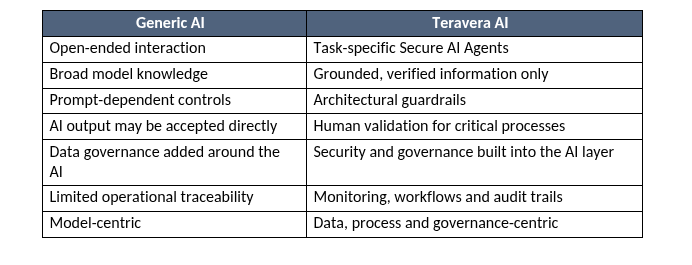
The distinction is important.
The goal should not be to find an LLM that is supposedly incapable of making a mistake. The goal is to design a system in which an AI mistake is prevented from becoming an operational or market-information failure.
From Risk Mitigation to Real Business Value
Risk controls should not make AI unusable.
For exchanges, the real opportunity is to combine safety with speed.
For instance, Teravera’s Corporate Actions and Announcements Processing Agents can automate significant parts of the announcement life-cycle, from ingestion and validation through summarisation, sentiment analysis, structured extraction and publication processes in seconds.
An exchange can therefore reduce manual effort and publication times while maintaining human oversight and improving consistency.
The same architecture can also support other regulated workflows, including regulatory compliance, knowledge management, securities identification and other capital-market processes.
Teravera AI Platform from pTools is already deploying secure AI agents with stock exchanges and financial organisations, allowing organisations to test these capabilities against their own data, processes and governance requirements before moving towards wider adoption.
This is an important distinction: organisations do not have to make a significant leap into autonomous AI. They can start with a controlled use case, measure the results, validate the controls and then scale.
The Future: Trusted AI for Market Infrastructure from Teravera AI Platform by pTools Software
The next phase of AI adoption in financial markets will not simply be about who has access to the most powerful model.
It will be about who can deploy AI with confidence.
For stock exchanges, confidence means knowing where the information came from, what the AI was allowed to access, how the output was generated, who reviewed it and what happened before it was published.
That requires more than an LLM. It requires trusted data, grounding, security controls, guardrails, monitoring, auditability and human judgement working together.
This is the principle behind Teravera AI Platform from pTools Software.
AI should not replace the controls that make financial markets trustworthy. It should operate within them.
By combining AI capability with controlled data environments, grounding, HITL workflows and governance.
Teravera AI Platform is helping exchanges and other regulated financial organisations move from experimenting with AI to deploying it responsibly in real-world operations. The reward is not simply automation.
It is the ability to make regulated market processes faster, more intelligent and more efficient, without compromising the trust on which financial markets depend.
About pTools
Teravera AI Platform from pTools is a leading provider of market information and AI-driven compliance solutions for stock exchanges and related organisations, including LOUs, NNAs, CSDs, CCPs, and central banks. Our portfolio includes packaged software, bespoke platforms, and fully supported services spanning AI-enabled Corporate Announcements Processing, Persistent Sanctions Screening, LEI and ISIN issuance, ESG data validation, asset tokenisation, and digital listings.
With offices in Dublin, London, and Bangalore, pTools supports organisations such as LSEG, Qatar Central Bank, and Strate South Africa. Our solutions leverage specialist capabilities in Artificial Intelligence and Natural Language Processing, blockchain and notarisation, sanctions risk scoring, and data quality management, and are delivered on-premise, in the cloud, or as fully managed services.
The company is a long-standing partner of the World Federation of Exchanges and collaborates with leading global technology providers, including IBM, AWS, Microsoft, and Intuition for financial sector eLearning.
For more information on pTools' Secure AI Solutions and to enquire about Proof of Concepts deployment, please contact: Suraj Pandey – Head of Business Development, AI & Market Information Services at suraj.pandey@ptools.com
To explore more of our AI solutions, visit: www.ptools.com & www.teravera.com
Disclaimer:
The views, thoughts and opinions contained in this Focus article belong solely to the author and do not necessarily reflect the WFE’s policy position on the issue, or the WFE’s views or opinions.