Islamic Finance: Connecting Originating Flow to Domestic Market Infrastructure
Islamic finance is built on a distinct foundation rooted in Islamic law (Shari’ah): the prohibition of riba (usury or interest). The Qur’an distinguishes between usury and trade, forbidding the former but allowing the latter (Qur’an 2:275). This principle underpins the Islamic finance emphasis on transactions linked to identifiable assets, ownership and economic activity rather than the provision of money for a predetermined return. The fact that trade and the exchange of real assets are central to many Islamic-finance structures creates a natural connection between financial activity and the real economy. Where a national economic and policy strategy seeks to ensure that liquidity has a functioning route into the domestic economy, the infrastructure supporting Islamic finance can also connect that activity to national markets.
Whenever an asset is traded on an organised market, it gets to create opportunities for different participants to express views, allocate capital and transfer risk. A functioning market can also support capital raising, investment and the development of domestic financial markets, but only if the given assets are representative of the domestic economy. In the case of Islamic finance, these can be eligible Shari’ah-compliant shares, ETFs or sukuk listed on a national exchange.
Due to the complexity of achieving Shari’ah compliance, Islamic finance is often discussed in terms of the rules governing financial contracts, which overshadows the broader economic value and goals that the system aims to establish. This makes the infrastructure through which Islamic financial transactions are executed more than a technical matter.
The distinction becomes particularly relevant in Tawarruq – a Shari’ah-compliant financing structure in which a customer acquires an identifiable commodity from a financial institution on deferred payment terms and subsequently sells that commodity to an independent third party for cash. The structure provides liquidity while generating the financier’s return through a sale transaction rather than an interest-bearing loan. Subject to the applicable Shariah standards and governance requirements, the underlying commodity transaction (conducted via a сommodity Murahaba or a ‘cost-plus’ contract) involves genuine ownership and transfer of the asset and provides the basis for the financing arrangement.
Three Market Models
Commodity Murabaha transactions require an underlying asset. In practice, commodities represented by warehouse warrants have often been used for this purpose. A warehouse warrant can provide evidence of title to a commodity stored at a recognised facility. At times, the country where storage is arranged differs from the country where the commodity Murabaha transactions are executed.
There is nothing inherently problematic in using a warehouse as part of the infrastructure. The question is what happens beyond the warehouse.
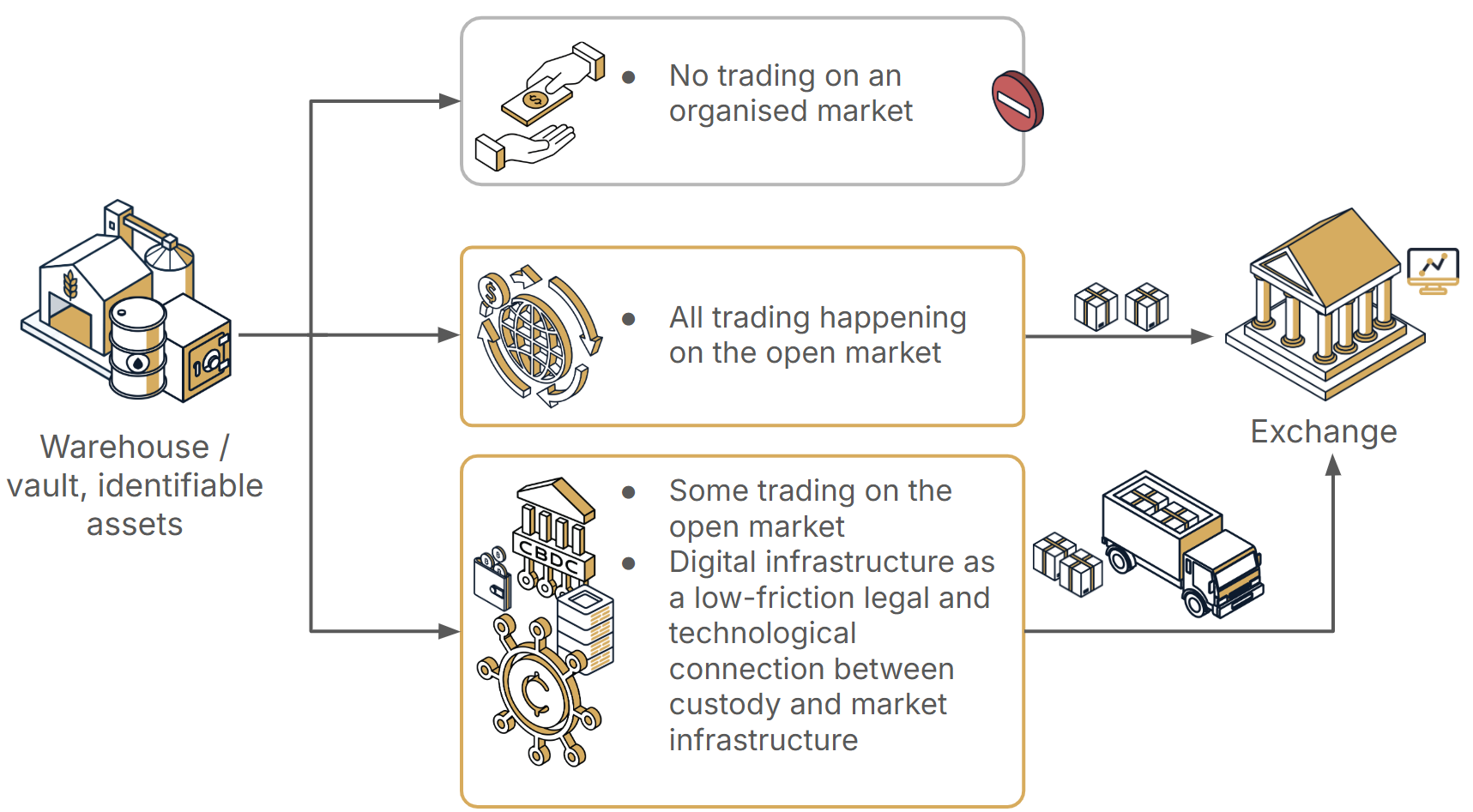
Consider three distinct models:
1. In the first, the commodity exists in a warehouse (or vault, in the case of precious metals) and is traded at the warehouse, and ownership changes are recorded through a chain of contractual entries. The asset may be perfectly identifiable, but the transaction has little or no connection to the market in which the financing is ultimately supposed to have an economic impact.
2. In the second scenario, the warehouse is connected to an organised market. Assets can enter and leave the system, ownership can change through recognised market mechanisms, prices can be discovered and published on market data feeds, participants can compete to provide liquidity, and transactions can ultimately affect the wider economy.
The first model focuses on recording an asset and the second on enabling that asset to participate in an economic system. An illustrative analogy is movement of a neutrino particle through a vacuum. A particle can travel through empty space with almost no interaction with its surroundings. Likewise, an asset represented only by entries in a database can move from one contractual position to another with very little interaction with the economic environment around it. A market introduces friction – but that friction is not necessarily a defect. It exists because the transaction is placed in real-life economic conditions, meets real risk and carries real impact.
3. The third scenario can feature varying combinations of the first two, depending on the proportion of the transactions that need to happen on-exchange. This model features a digital central securities depository (CSD) and tokenised cash in the form of stablecoins and central bank digital currencies (CBDCs) that represent a functioning, low-friction legal and technological connection between custody and market infrastructure.
The first scenario is currently prevalent in Tawarruq transactions in the GCC region. Assets remain in the Warehouse in Europe, while transactions occur around them. Given the average daily volatility of the underlying assets, broker fees of as little as $5 per $1,000,000 of transaction value and duration of buyback promises measured in hours, if not days, make the compliance requirement for a customer to retain at their full discretion the asset acquired as a part of Murabaha workflow economically impossible as the value of such promises exceeds the fee a thousand times.
Without a credible connection between the asset, ownership, transfer and market, it becomes much harder to demonstrate a transaction’s genuine economic impact. A powerful illustration of why this matters is the Dubai Financial Services Authority (DFSA) case published 2019: the regulatory body describes how a commodity Murabaha broking desk had reused old warrant numbers (bearer documents representing title for LME metals) for Murabaha transactions for two years after losing its supplier of valid warrants.
At the other end of the spectrum, transactions are executed directly through the exchange and its established clearing and settlement infrastructure. The fees incurred are substantially higher in this scenario.
Between these extremes is a hybrid model: a pool of assets can remain in a controlled custody environment, while selected transactions are routed through the market when assets need to enter or leave that pool or when market liquidity and price discovery are required.
The physical analogy could be a warehouse connected to the market by a road. Not every item has to travel along the road every minute. But the road has to exist, and the system has to be capable of using it when required.
A Digital Route Between Assets and Markets
The objective is not simply to digitise existing commodity Murabaha processes. It is to create an environment in which Islamic-finance liquidity can remain connected to the domestic financial system – linking banks, investors, exchanges, clearing and settlement infrastructure, eligible assets and regulators. A process lacking these connections is unlikely to be Shari’ah-compliant.
For the buy-and-sell activity to contribute to the real economy in a meaningful and sustainable way, it is crucial that the connection between the market and the warehouse be accessible to participants, and not excessively expensive. Ways to decrease infrastructure-related costs include:
- High performance and compute power of the systems involved.
- Human agency – each participant has real ownership and risks. To decrease risks, the decisions made at the discretion of each party should be taken in short timeframes. Agency should be combined with speed via agentic automation.
- Added efficiency in the form of an intermediary warehouse accessible on demand and obtaining stablecoins, CBDCs and tokenised cash in a digital CSD.
- Monitoring and compliance systems recording information to a distributed ledger that is available on a permission basis to regulators, the exchange, the liquidity providers and other participants.
The Exactpro team has recently contributed to developing Murabex – an enterprise-grade digital finance platform that enables financial institutions to streamline the execution of commodity Murabaha agreements for their customers. Murabex is designed around the same principles: rather than treating the underlying asset as an isolated entry in a commodity registry, it connects domestic and international Islamic-finance workflows with national market infrastructure into a robust, consolidated ecosystem. It supports different deployment models according to the requirements of each jurisdiction.
If Islamic finance is intended to support the real economy, its infrastructure should give capital a route into real economic activity. Murabex provides that route and a strategic opportunity to move away from disconnectedness and empty paperwork and towards cohesion and meaningful impact, while making the underlying economic events more reliable, traceable and auditable.
About Murabex
We look forward to further discussing with the WFE community the potential of sovereign Islamic finance markets to drive national economies forward. You can reach us via info@exactpro.com and learn more about Murabex at murabex.com.
Disclaimer:
The views, thoughts and opinions contained in this Focus article belong solely to the author and do not necessarily reflect the WFE’s policy position on the issue, or the WFE’s views or opinions.