Measuring IPO Admission Rules: The Listing Stringency Index
Written by Dr. Ishak Demir, Economist at the WFE
The Listing Stringency Index (LSI) is a survey-based composite measure developed by the WFE research team using data from 40 WFE member exchanges. It quantifies and compares IPO listing requirements across nine regulatory dimensions and provides a standardized framework to analyse the relative stringency of listing regimes without prescribing any specific regulatory design.
The index covers nine dimensions that structure IPO admission: financial requirements; voting rights; IPO costs; share price and distribution; corporate governance; disclosure obligations; operational requirements; regulatory approvals; and tax incentives or obligations. These map to concrete levers such as free float and shareholder counts, board independence and audit committees, prospectus approval and securities-law compliance, ongoing disclosure (including ESG), listing-related tax provisions.
The LSI uses binary (yes/no) responses to detailed sub-questions within each dimension; a dimension’s score is the percentage of applicable sub-criteria required. The overall LSI is the ratio of the total number of restrictions imposed to the total number of applicable restrictions across all dimensions, expressed on a 0–100 scale, using an additive structure with equal treatment of sub-questions to ensure comparability across jurisdictions.
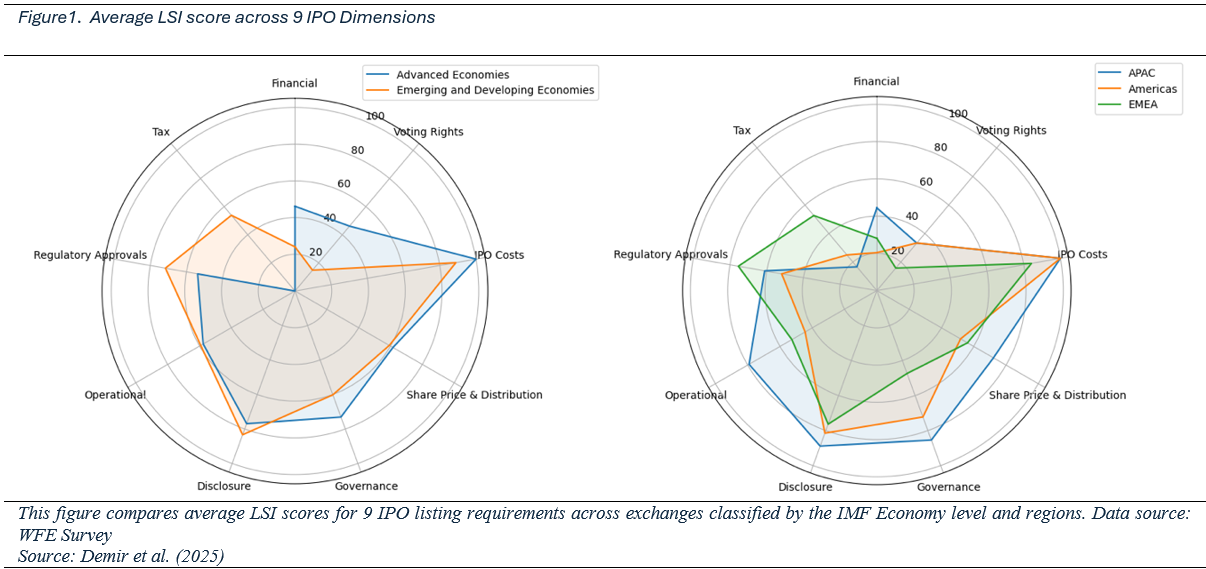
Figure 1 compares average scores by IMF economy level and by region, showing where rules are tighter or looser across LSI dimensions. Disclosure requirements and IPO costs are the most widely enforced across groups, while financial requirements and voting rights are among the least frequently applied. Across all exchanges, the LSI itself averages 58.67 (range 33.33–88.89), indicating that, on average, exchanges impose slightly more than half of the criteria.
Differences by economy level and region are visible in Figure 1. Exchanges in advanced economies tend to impose stricter requirements in areas such as corporate governance and regulatory approvals, whereas exchanges in emerging and developing economies show relatively greater emphasis on operational requirements and tax-related tools. Regionally, APAC stands out with higher average scores in operational requirements, governance, share price and distribution, and disclosure; EMEA displays relatively balanced stringency across most categories; and the Americas show moderate emphasis on governance and tax, with comparatively lower levels in operational and financial criteria.
Areas of convergence are strongest around disclosure and legal conformity within the regulatory approvals dimension: 87.5% of exchanges require compliance with securities laws and 80% mandate formal prospectus approval. At the same time, divergence is most visible in threshold-type levers—financial criteria, voting rights, and tax—which reflect local regulatory philosophies, institutional capacity, and strategic priorities. The LSI captures these contrasts as a comparative lens for evaluating regulatory scope rather than prescribing specific design.
Overall, the LSI provides a transparent way to benchmark the breadth of IPO listing requirements across nine dimensions and to compare patterns by region and economy level. It shows that exchanges share a common backbone around disclosure and key approvals while differing in the selective use of financial, voting, and tax settings—differences that help explain how jurisdictions balance accessibility and investor protection without assuming a single global rulebook.
This note is part of the ongoing WFE Research project on IPO landscape. If you have any questions or comments, please contact Ishak Demir ([email protected]).
References
Demir I., Ghofrani I. and Liu Y. (2025). The Listing Stringency Index (LSI): A Global Metric for IPO Accessibility. WFE Research Report.