Proportionality in the EU's AMLCFT Framework: Strategic Approaches for AMLA
Introduction
The European Union's Anti-Money Laundering Authority (AMLA) plays a crucial role in the formulation and enactment of Level 2 and Level 3 measures, pursuant to the EU Anti-Money Laundering Regulation and Directive. Its responsibilities extend to direct supervision, fostering supervisory convergence, and amplifying cooperation among National Supervisors and Financial Intelligence Units across the EU to effectively combat money laundering and terrorism financing. As a nascent agency, AMLA is currently in the process of establishing its internal governance structures and operational capacity to fulfil its functions.
The application of the proportionality principle features prominently in the AMLA Regulation. This article, the third by the author dedicated to this subject, seeks to delineate strategies through which AMLA can realise proportionality within its mandate, thereby bolstering the EU's imperative for enhanced competitiveness. In pursuit of this objective, the article advocates for: [a] the implementation of a principles-based regulatory approach, augmented by supervisory cooperation and convergence, in order to cultivate mutual and collective trust among AMLCFT supervisors throughout Europe; [b] the implementation of a regulatory maturation process; and [c] the employment of cost-benefit analyses incorporating a proportionality and competitiveness assessment.
The insights presented in this article are derived from the author’s discussions with eminent experts in the field of EU financial regulation and supervision and are extended to assist AMLA in advancing its organisational objectives. Previous articles on this subject by the author have been published in the IPS Journal and the Journal of Financial Compliance. This article is a continuation of the narratives in these articles.
[A] Principles-Based Regulation and Supervisory Convergence
The risk-based approach has become synonymous with the area of AML/CFT. Implementing a principles-based approach should therefore be a natural choice for AMLA and it would enable it to tailor regulatory measures to the heterogeneous risk characteristics present across different entities and sectors. This approach would aim to enhance the efficacy of measures designed to deter financial crimes while concurrently mitigating disproportionate regulatory burdens on smaller enterprises and emerging startups. However, it can lead to divergences in interpretation and application across Member States. Such variability may result in regulatory arbitrage, a phenomenon where businesses capitalise on regulatory discrepancies between jurisdictions to minimise compliance costs or regulatory burdens. Regulatory arbitrage undermines the integrity of the internal market, leading to an uneven playing field among Member States. Addressing regulatory arbitrage and its negative consequences was one of the reasons for the AML Package and one has to ensure that AMLA does not therefore become a self-defeating proposition.
To alleviate concerns of regulatory arbitrage and prevent the imposition of supervisory barriers to cross-border business by National Supervisors, it is essential to accompany principles-based regulatory harmonisation with a high degree of supervisory convergence and cooperation. Various mechanisms can facilitate this process, including peer reviews, supervisory colleges, the sharing of supervisory resources, joint supervisory engagements, and regular meetings coordinated through specialised supervisory committees. These tools foster mutual trust - confidence in each other’s supervisory actions - and collective trust - a shared commitment to supervisory objectives - among national supervisors, which are crucial for the effective oversight of the European AML/CFT landscape.
By way of example peer reviews represent a pivotal mechanism in the pursuit of harmonising supervisory outcomes by focusing on critical areas that substantially influence consistency across jurisdictions. For these reviews to be truly impactful, it is essential to prioritise topics that can make the most significant difference in strengthening supervisory coherence and alignment. To optimise their effectiveness, peer reviews necessitate a strategic and clearly defined prioritisation framework. This framework should guide the selection of review topics and ensure that the issues with the greatest potential to enhance supervisory consistency are given precedence. Moreover, the governance structure of peer reviews requires meticulous attention. A systematic approach to follow-ups is imperative, ensuring that the insights and recommendations from peer reviews translate into tangible improvements.
Convergence and cooperation mechanisms are already established under the frameworks of the European Supervisory Authorities (ESAs). Therefore, it is safe to suggest that AMLA should leverage the existing structures and experiences of the ESAs to avoid redundant efforts. By drawing on the practical developments, strengths, and weaknesses encountered by the ESAs, AMLA can enhance its supervisory convergence and cooperation frameworks, fortifying the integrity and efficiency of the internal market against potential exploitation through regulatory arbitrage, while at the same time ensuring that the European financial system remains competitive.
[B] Establishing a Regulatory maturation process
To enhance the effectiveness of a principle based AML/CFT Single Rulebook, it is imperative for AMLA to institute a comprehensive regulatory maturation process. In anticipation of the evolution of the AML/CFT Single Rulebook, it is prudent to advocate for a regulatory maturation approach that begins with the identification of new areas for regulatory development. This initial phase involves collaboration with co-legislators to transform identified areas into a Level 2 mandates. AMLA would then develop this mandate into technical standards or guidelines, which are subsequently adopted by co-legislators.
During the developmental stage, it is imperative to delineate clear regulatory and supervisory objectives beforehand and to identify the most appropriate instruments from AMLA’s repertoire of supervisory convergence tools to effectively attain these goals. The process should initiate with the dissemination of relevant information and the provision of targeted training to national supervisors, followed by the implementation of active oversight activities. It should then transition into ex-post evaluations and enforcement actions. This iterative, recurring methodology would facilitate continuous refinement through periodic review, allowing for amendments or repeals of regulatory measures as necessary to maintain their pertinence, proportionality, and efficacy over time.
Regulatory Maturation Process
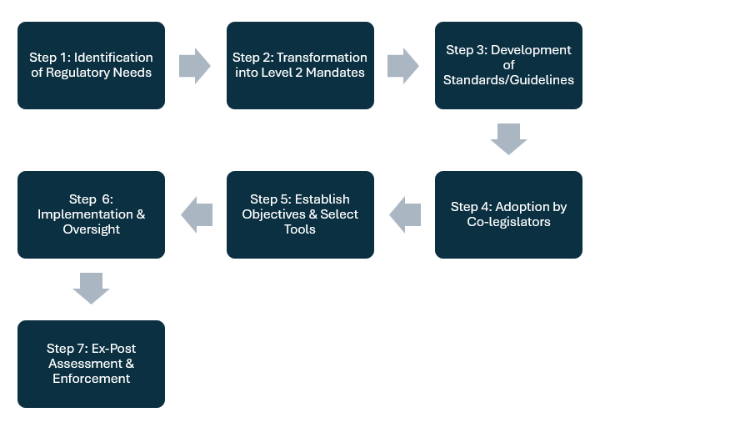
A diagram of steps to a maturation process
Implementing a regulatory maturation process as outlined would foster a more proportionate regulatory environment by ensuring that regulatory measures evolve in alignment with actual risk profiles and operational realities.
[C] Cost-Benefit Analysis: Ensuring Evidence-Based Evaluation of Regulatory Proposals
For each proposed regulatory measure, a comprehensive cost-benefit analysis (CBA) should be conducted in accordance with the EU’s established principles of better regulation, which emphasise transparency, stakeholder engagement, proportionality, and evidence-based decision-making. Central to this process would be an approach which requires an objective, evidence-driven assessment that rigorously evaluates the proportionality of the proposed regulation. This would entail determining whether the regulatory intervention is appropriate and commensurate with its intended objectives. Additionally, the analysis would need to scrutinise the potential impact of the regulation on the EU’s competitiveness, in line with the Mario Draghi recommendations, including a comparative review of similar regulatory frameworks adopted by third-country jurisdictions. Such benchmarking is essential to prevent regulatory measures from unduly constraining market growth or placing EU entities at a competitive disadvantage.
Conclusion
In conclusion, AMLA has a significant opportunity to shape a proportionate, effective, and forward-looking AML/CFT regulatory framework from the very outset. By prioritising a principles-based approach and fostering robust supervisory convergence, AMLA can build a resilient supervisory environment rooted in mutual trust between competent authorities. Establishing a comprehensive regulatory lifecycle, from initial needs assessment through development, implementation, and ex-post review, will ensure that regulations remain relevant, effective, proportionate and evidence-based. Furthermore, integrating rigorous cost-benefit analyses that emphasise proportionality and competitiveness will help prevent regulatory overreach and safeguard the EU’s market position. Embracing these strategies will not only enhance AMLA’s capabilities but also contribute to a more consistent, predictable, and competitive AML/CFT landscape across Europe, ensuring that the regulatory framework effectively supports the EU’s broader economic objectives from the very beginning.
Disclaimer:
The views, thoughts and opinions contained in this Focus article belong solely to the author and do not necessarily reflect the WFE’s policy position on the issue, or the WFE’s views or opinions.