Planting Seeds for Financial Literacy: the Swiss Finance Museum's Children’s Book
Financial literacy is a lifelong journey, but the seeds are best sown early. Alongside several financial literacy initiatives, the Swiss Finance Museum (SFM) introduces another way to teach children about money - with a storybook adventure narrated by a dog.
“It's good to know your way around money. After all, you’ll be dealing with it all the time!”
On the final page of Luna entdeckt das Geld, a vividly illustrated children’s book, Luna, the Standard Poodle narrator, addresses these final words to her young readers before wishing them goodnight. After a day full of money-related adventures, Luna concludes the story by encouraging people to invest in their financial literacy.
According to the OECD, financial literacy “entails having the knowledge and comprehension of financial concepts and risks, along with the skills and attitudes needed to apply this understanding to make effective decisions across a range of financial contexts.” It greatly affects one's money habits and is best introduced at an early age. As a 2015 study by the German Institute for Economic Research highlighted, financial socialisation, like other forms of socialisation, takes place in the early years of life. It is shaped by school, work and family, with family having the greatest influence on children.
However, studies also suggest that many adults, and by extension, their children, lack basic financial knowledge. This applies to countries with sophisticated financial systems, albeit to a lesser extent, as a 2019 study by Klapper & Lusardi shows.
For example, Switzerland, with its rich financial heritage, does not pursue a national strategy in terms of financial education. However, we are facing an increasingly complex financial landscape. And there is a need for initiatives that equip people with the relevant skills. These initiatives are best started early, not least because younger generations are increasingly involved in and affected by simplified financial transactions. One example is the Richard Thaler and Cass Sunstein argue that nudging is a powerful tool in shaping behaviour and leads people to make better decisions. In terms of financial literacy, exposing children to these concepts by weaving them into everyday stories, games and experiences makes them accessible, relatable and memorable. Since children are naturally curious and open to new ideas, they are especially receptive to nudging. It’s an important and effective element in their journey to financial literacy.
As the researcher Hersh Shefrin highlighted in a recent article in Forbes Magazine, nudging Gen Z and younger generations toward sound financial decisions is not just about providing information. It is about creating environments and experiences that make good choices easy and intuitive. Another piece of research, conducted by Kuswati in 2019, outlines the positive influence of engaging narratives and visual storytelling on children’s understanding of money and financial decision-making. The earlier children are exposed to these concepts, the more likely they are to develop positive financial behaviours that last a lifetime.
This is Part of the mission of the Swiss Finance Museum (SFM), Switzerland’s first - and only - finance museum. The SFM was founded in 2017 and wants to appeal to the younger generation by providing information about the financial markets and their infrastructure, as well as the financial history. Through this, the seeds of financial literacy are planted early on.
Guided tours and workshops allow children and teenagers to explore the world of finance through engaging and educational content. Participation in Swiss Money Week, which is part of the OECD’s broader Global Money Week initiative, further strengthens SFM’s efforts to promote financial literacy. Moreover, the museum expanded its presence on social media. Initiated and managed by the SFM’s apprentices, a TikTok channel introduces Gen Z to different financial concepts – with considerable success. Since its launch in 2023, content on the channel has repeatedly gone viral and museum entries in the relevant age category doubled.
Introducing a Storybook Solution
Just in time for World Investor Week, the SFM is launching a children’s book on the Swiss market. It will be available in German at first. Developed in partnership with Baeschlin, the renowned children’s book publishing house, the story follows Luna, a Standard Poodle and a character in an existing series of books. In this issue, Luna is navigating the world of money for the first time.
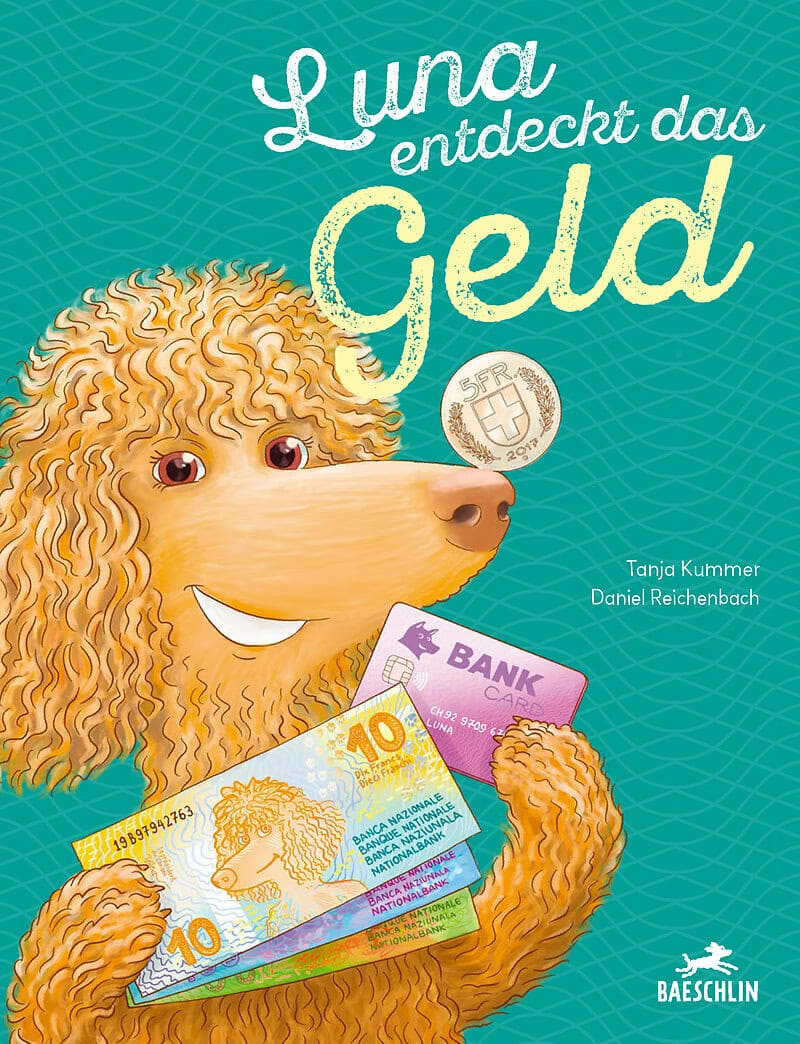
Luna goes on adventures that shed light on various financial concepts. For example, she encounters a street musician collecting money both in a hat and via QR code, introducing young readers to different payment methods. In “explainer boxes”, this and many other concepts such as trade, currency, budgeting and investing are broken down and further explained in child-friendly language. This means that the book can be enjoyed by readers of all ages: younger readers can enjoy the story without the boxes, while older children can read them to gain deeper insights.
The book’s concept was developed in close collaboration with Tanja Kummer, a renowned author of children’s books, ensuring that the storyline surrounding the financial concepts is both engaging and age appropriate. The author crafted the narrative in a way that makes complex financial topics accessible to young readers, while Daniel Reichenbach, the illustrator, brought the story to life with vibrant, easy-to-understand visuals.
Andrea Weidemann, Director SFM, emphasises the story’s entertaining and educational aspects: "There are very few children’s books that are both visually appealing and tell a compelling story about money. We wanted to create something beautiful and educational - a book that parents and children can enjoy together, while gently nudging kids toward smart financial habits."
To celebrate the launch, the museum hosted a special event just before World Investor Week, where the author and illustrator brought Luna’s world to life with a live reading from the new book. Visiting families received a behind-the-scenes look at how the story and illustrations came together and had the chance to explore the colourful artwork up close and discover financial concepts in a fun, interactive way.
An Illustrated Call to Action
As we celebrate World Investor Week, let’s remember that financial literacy is not a one–time lesson, but a lifelong journey. The earlier we start, the better the outcomes. Financial institutions have a role to play in planting the seeds of financial literacy and nurturing them as they grow.
The SFM is mainly funded by SIX, a trusted institution at the heart of the financial system. They both play a unique role in promoting financial literacy and are well positioned to reach a broad audience and to set the tone for responsible financial behaviour. The new book is just one example of how a difference can be made. By starting with the youngest members of society, SIX and the SFM can help ensure that the next generation is better equipped to navigate the financial world. This ultimately benefits individuals, markets, economies and society.
See more here: baeschlinverlag.lesestoff.ch
Disclaimer:
The views, thoughts and opinions contained in this Focus article belong solely to the author and do not necessarily reflect the WFE’s policy position on the issue, or the WFE’s views or opinions.