From ESG to EGCX: How the Egyptian Climate Exchange Is Driving Sustainable Finance and Market Transformation
The Egyptian Exchange (EGX) has cemented its position as a regional leader in sustainability. This milestone year was defined by impactful initiatives, strategic partnerships and a visionary approach to embedding Environmental, Social and Governance (ESG) principles into the heart of Egypt’s financial market. These efforts not only enhance transparency and attract sustainable investment but also contribute directly to Egypt’s national decarbonisation roadmap. EGX’s ambition is clear: to be a key driver of the just transition and a global blueprint for stock exchanges.
1. The Egyptian Climate Exchange (EGCX): The Sustainability Gateway
The year’s most significant milestone was the strategic rebranding of the Pan-African Regulated Voluntary Carbon Market, AfricarbonX, to the Egyptian Climate Exchange (EGCX). This move positions EGCX as a “sustainability gateway” for green finance in the region. With 34 projects registered, 170,000 carbon credits available for trading and the execution of initial landmark transactions totalling 5,500 credits, the exchange is gaining strong early traction.

EGCX’s dual growth strategy
EGCX is pursuing an ambitious, two-pronged expansion plan:
- Vertical growth: Strengthening its core by focusing on robust certification and verification mechanisms. It is also introducing new sustainable financial instruments, such as I-RECs (International Renewable Energy Certificates) and green bonds, to attract a wider range of investors.
- Horizontal growth: Expanding its geographic reach into new countries to enhance visibility and align with international best practice.
2. Pioneering Regulatory and Policy Engagement
EGX’s proactive approach to global standards and domestic policy has set it apart.
Strategic partnership on climate governance
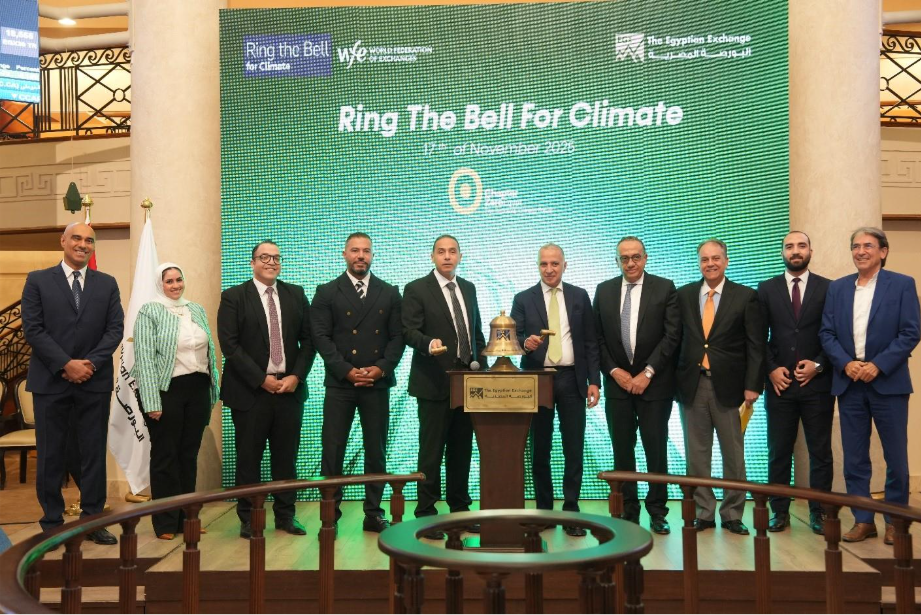
Under the WFE Ring the Bell for Climate initiative, EGX reinforced its commitment to elevating corporate climate action by signing a landmark Memorandum of Understanding (MoU) with Chapter Zero Egypt in November 2025. This partnership is designed to empower boards of listed companies with the tools and expertise needed to integrate climate governance into core business strategies. It focuses on joint awareness campaigns, capacity building and knowledge exchange to drive systemic change across the market.
Corporate readiness and capacity building
A flagship initiative involved preparing listed companies for the European Union’s Carbon Border Adjustment Mechanism (CBAM), which imposes carbon tariffs on high-emission imports. EGX hosted targeted seminars for the six most affected sectors (fertilisers, iron and steel, cement, aluminium, electricity and hydrogen) to ensure readiness.
EGX also advanced capacity building and investor education through several training initiatives, including:
- A programme on ISSB Standards (with UNSSE, IFC and IFRS) to prepare companies for new sustainability reporting requirements.
- A training programme on Gender Equality in Capital Markets (with UNSSE, UN Women and Bloomberg).
These initiatives are essential to expanding investor education and helping market participants navigate the evolving sustainable finance landscape.
3. African Market Leadership and Global Integration
EGX’s influence extends far beyond Egypt’s borders. It continues to lead the continent’s sustainability agenda through its chairmanship of the ASEA Sustainability Working Group (SWG), helping to harmonise standards across African exchanges.
In collaboration with the African Development Bank (AfDB), EGX participated in the ESG Forum, which led to a joint initiative to establish Africa’s first comprehensive ESG Disclosure Centre – a project aiming to embed sustainability principles into the continent’s financial infrastructure.
In parallel, EGX maintains active participation in key global and regional platforms, including:
- WFE Sustainability Working Group (SWG): Active Member shaping global sustainability strategy.
- FEAS SWG: Leading Participant advancing Euro-Asian ESG harmonisation.
- AFCM: Active Exchange promoting sustainability across Arab capital markets.
- UNSSE: Active Member strengthening the global sustainable exchange network.
EGX further demonstrated UNSSE thought leadership through contributions to two landmark publications: Model Guidance on Climate Transition Plans and How Exchanges Can Promote Sustainable SMEs. These contributions underscore EGX’s role as a leading exchange across multiple SWGs and as a pivotal UNSSE member.
Conclusion
The Egyptian Exchange’s initiatives highlight a clear, forward-looking strategy and a firm commitment to building a resilient, transparent and sustainable market. By integrating ESG standards, expanding capacity building and launching the pioneering EGCX, EGX is cementing its position as a key driver of sustainable finance in Egypt, across Africa and globally. EGX is not merely adapting to the future – it is actively shaping it, serving as an inspirational model for emerging exchanges worldwide as they support the just transition towards a decarbonised, inclusive global economy.