Sustainability Still Matters: Why Malaysia and ASEAN Must Stay the Course
The Association of Southeast Asian Nations (ASEAN) which comprises Brunei, Cambodia, Indonesia, Laos, Malaysia, Myanmar, the Philippines, Singapore, Thailand and Vietnam faces disproportionate risks from climate change. ASEAN contributes just 7 percent of global carbon-dioxide emissions; Malaysia’s share is less than 1 percent. The potential economic consequences are staggering.
Asian Development Bank1 estimates that the region could lose up to 11 percent of its GDP by 2100 if climate change is left unaddressed. These projections underscore the urgency for ASEAN nations to act decisively to mitigate environmental risks and preserve economic stability. The transition to sustainable development is no longer an option. It is a strategic imperative that must be supported by significant financial resources and structural reforms.
The region's shift towards sustainability requires large investment, with an estimated USD6.7 trillion by 2050 to support energy transition and sustainable growth.2 Capital markets play a vital role by facilitating access to funding for sustainability projects. For Malaysia, the transition is critical.
ASEAN’s Regional Response: Frameworks for Credibility
ASEAN is determined for its transition journey to be just, orderly, inclusive and credible. Amid concerns over greenwashing and in response to persistent challenges around inclusivity and interoperability, ASEAN regulators are focused on providing companies with the guidance they need to embark on credible transition pathways.
The ASEAN Taxonomy
The ASEAN Taxonomy for Sustainable Finance provides a framework to guide sustainable investments. Its “traffic light” system classifies economic activities as green, amber or red, offering a flexible and regionally relevant way to measure sustainability. The inclusion of an amber category allows for progressive activities that are not yet fully green but are on a credible path to sustainability.
The ASEAN Taxonomy aligns with global frameworks, including the EU Taxonomy and the Paris Agreement’s 1.5°C target. Technical criteria have been developed for the energy, transportation and storage, construction and real estate and for the carbon capture, storage and utilisation (CCUS) enabling sector. Version 4 of the Taxonomy, set to be released in 2025, will cover the remaining focus sectors of Agriculture, Manufacturing and Water and Waste Management and facilitating sectors of Information and Communication and Professional, Scientific and Technical activities.
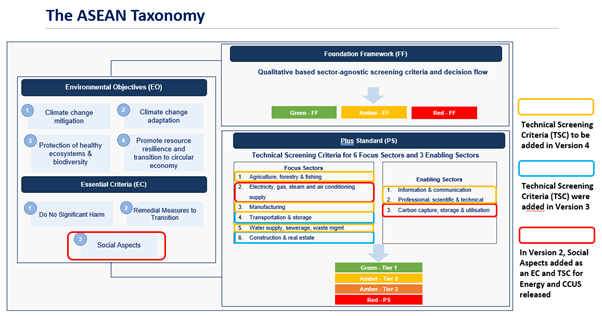
This regional approach has gained global recognition. The ASEAN Taxonomy has been named one of three acceptable taxonomies by the Financial Services Regulatory Authority of Abu Dhabi and has inspired other jurisdictions to explore similar models.3
The ASEAN Transition Finance Guidance
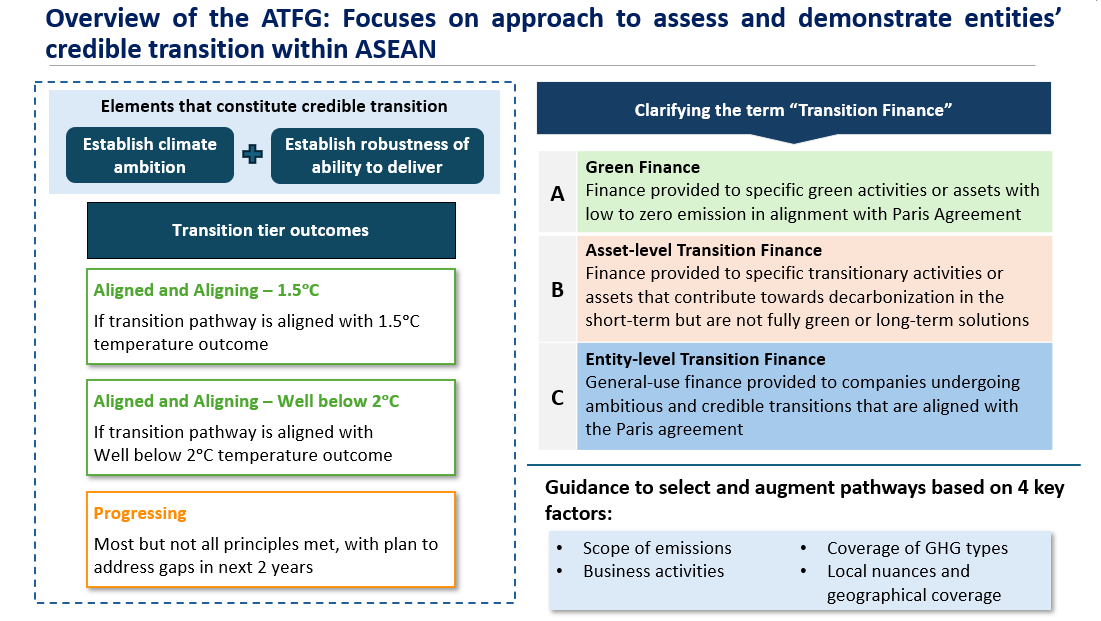
Complementing this is the ASEAN Transition Finance Guidance (ATFG). It provides detailed criteria to help entities in ASEAN define and assess credible transition strategies. The ATFG supports companies in developing transition plans that can attract financing and includes a three-tier credibility assessment based on a company’s climate ambition and execution strategy. By incorporating global best practices from GFANZ and ICMA, while tailoring them to regional realities, the ATFG fosters both credibility and accessibility.
Malaysia’s Climate Commitments and Efforts
Malaysia’s Climate Commitments
Malaysia has pledged to reduce greenhouse gas emissions intensity by 45 percent by 2030 (relative to 2005 levels) and aims to achieve net-zero emissions by 2050. To achieve these goals, the Malaysian government estimates that RM1.85 trillion in funding will be needed. To guide this transition, three national frameworks have been launched: the National Industrial Master Plan 2030 (NIMP 2030), the National Energy Transition Roadmap (NETR), and the forthcoming National Adaptation Plan (MyNAP).
Malaysia’s Efforts
NIMP 2030, launched in 2023, outlines a decade-long vision to boost Malaysia’s industrial sector by promoting sustainability, competitiveness and resilience. It integrates climate and energy considerations, with a focus on industrial decarbonisation and the adoption of renewable energy. Meanwhile, the NETR sets the blueprint for reducing dependence on fossil fuels and expanding green energy, identifying ten flagship projects to spearhead this shift.
Complementing these is the MyNAP, currently under development, which aims to enhance Malaysia’s climate resilience across critical sectors including agriculture, water resources and infrastructure.
Ensuring that the transition is just and inclusive is at the heart of Malaysia’s approach. According to the NETR, the energy sector contributes 28 percent of GDP and employs 25 percent of the total workforce, hence a sudden overhaul could potentially be destabilising.
Advisory Committee on Sustainability Reporting
Malaysia has made notable strides in adopting international sustainability reporting standards. The Securities Commission Malaysia (SC Malaysia) chairs the Advisory Committee on Sustainability Reporting (ACSR), which oversees the phased implementation of ISSB standards.
National Sustainability Reporting Framework (NSRF)
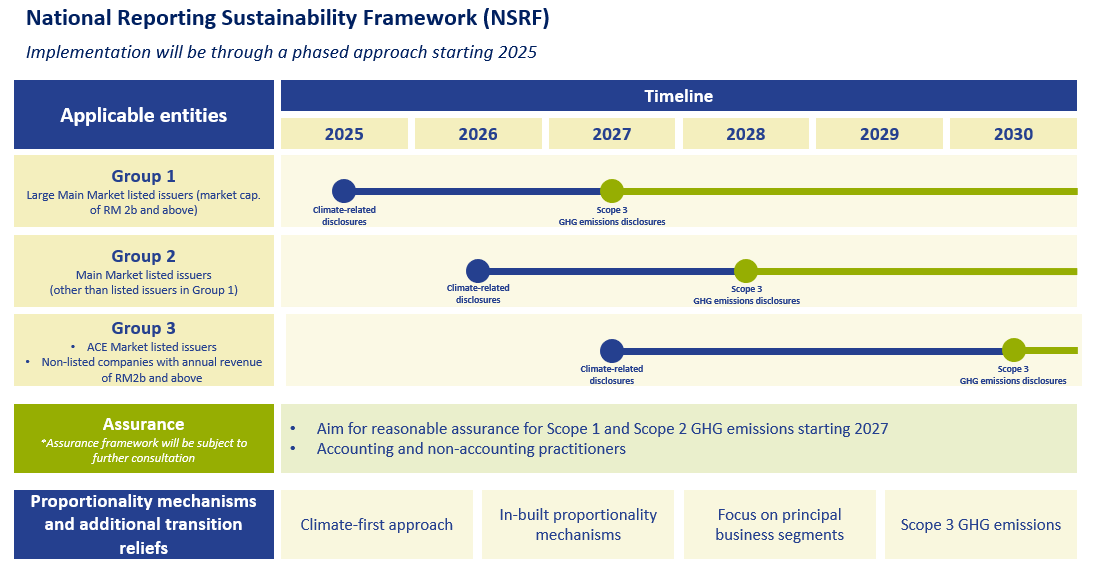
Recognising the different maturity levels of businesses, Malaysia has adopted a climate-first approach for the first two years, supplemented by transitional reliefs and capacity-building initiatives under the National Sustainability Reporting Framework (NSRF).
Policy, Assumptions, Calculators, Education (PACE)
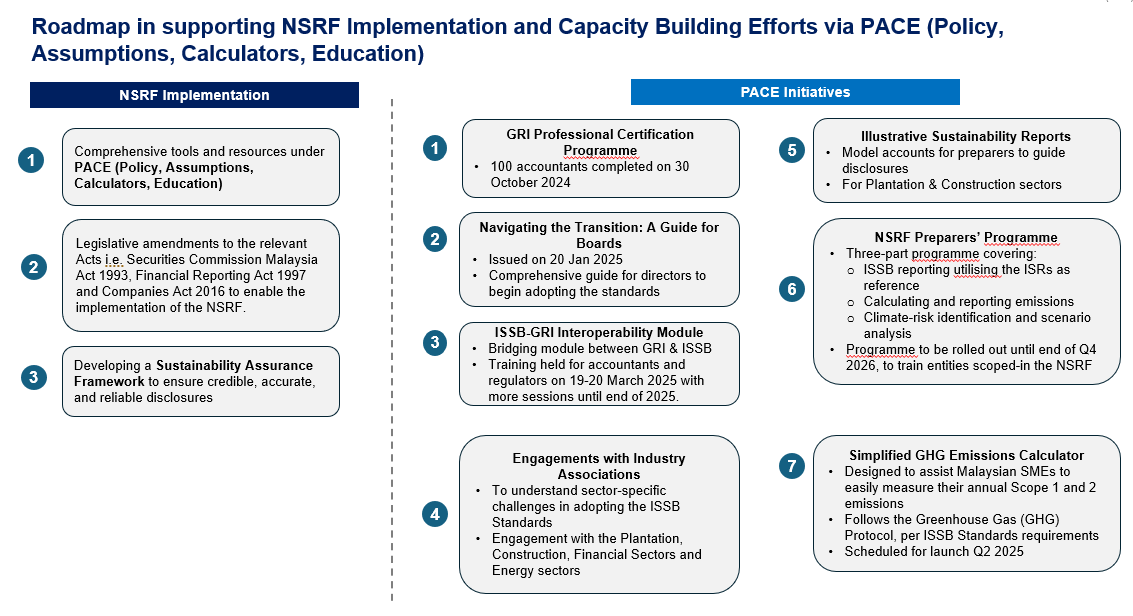
The Policy, Assumptions, Calculators, Education (PACE) initiative under NSRF offers practical tools to support adoption. It includes a board-level guide on sustainability governance, a GRI-ISSB interoperability module and illustrative industry-specific sustainability reports. These tools help companies understand and implement effective disclosures. Capacity building also focuses on technical challenges such as Scope 3 emissions and scenario analysis, ensuring comprehensive readiness.
Small and medium-sized enterprises (SMEs), which form the backbone of Malaysia’s economy, are also receiving targeted support. The Department of Statistics Malaysia reports that SMEs contribute 37.4 percent of GDP, employ nearly half the national workforce and play key roles in critical export sectors. Ensuring that SMEs can participate in the sustainability journey is essential to achieving Malaysia’s broader economic and environmental goals.
Simplified ESG Disclosure Guide for SMEs in Supply Chains (SEDG)
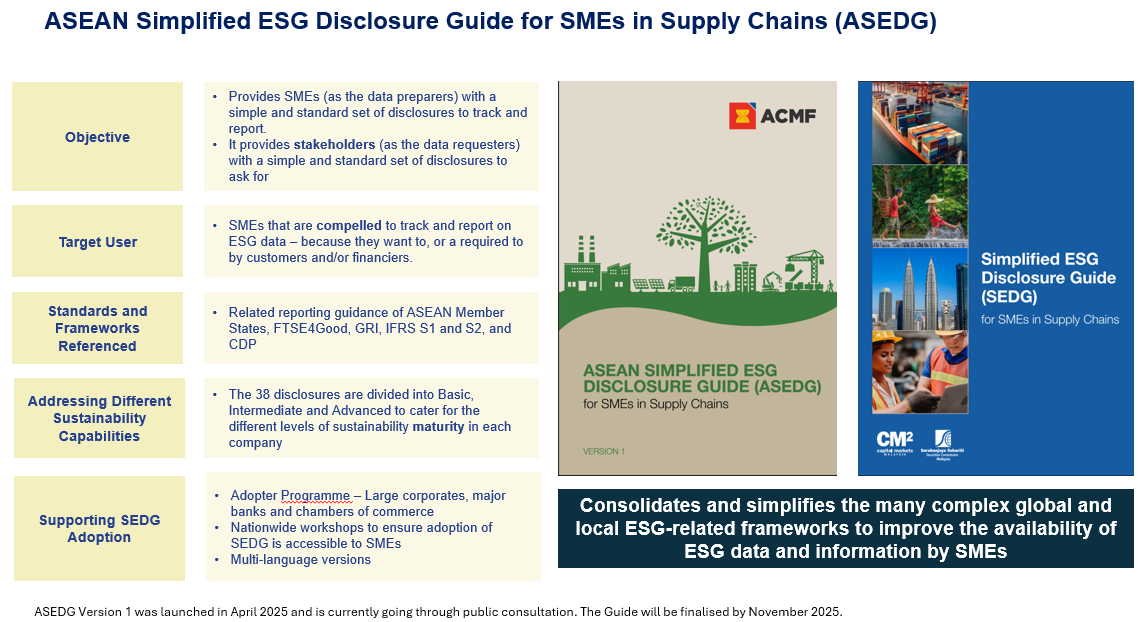
In October 2023, SC Malaysia launched the Simplified ESG Disclosure Guide for SMEs in Supply Chains (SEDG), making Malaysia the first country globally to provide SMEs with a streamlined and standardised set of guidelines in relation to ESG disclosures. Recognising the significance of supporting SMEs within supply chains to begin ESG reporting and understanding the challenges faced by SMEs, the SEDG was drafted in simple language and translated into Bahasa Melayu and Simplified Chinese to aid wider adoption in Malaysia. The SEDG comprises 35 priority disclosures that are aligned with local and global sustainability guidelines, categorised into Basic, Intermediate and Advanced, to cater to the different levels of sustainability maturity of each SME.
Emissions calculation and reporting remains a challenge for SMEs. Recognising this, SC Malaysia will launch a Simplified GHG Emissions Calculator in July 2025, offered at no cost to Malaysian SMEs. The tool helps SMEs estimate their Scope 1 and 2 emissions and emissions intensity using Malaysian-specific data. This further enhances their ability to meet disclosure requirements under the SEDG and strengthens their position in global supply chains.
SMEs across ASEAN are facing similar challenges in ESG adoption and reporting. An ASEAN version of the SEDG was developed and launched in April 2025 by the ASEAN Capital Markets Forum (ACMF). The ASEAN SEDG Version 1 incorporates all 35 disclosures of the Malaysia SEDG plus an additional three and maps each disclosure with the frameworks and guidance of each of the 10 member states for ease of reference.
Another key support mechanism is the Strategic Co-Investment Fund (CoSIF), which mobilises public and private capital to fund green SMEs through Equity Crowdfunding and P2P Financing platforms. The fund targets emerging sectors such as CCUS, EV, renewable energy and advanced materials, those aligned with Malaysia’s NIMP 2030. By co-investing with the private sector, CoSIF lowers the barrier to entry for innovation-driven SMEs, ensuring their competitiveness in a sustainable economy.
Staying the Course
While political debates in other regions may shift or delay climate action, Malaysia and ASEAN remain committed to staying the course. This determination ensures the credibility of their efforts and helps safeguard the livelihoods of millions, particularly small and medium-sized enterprises (SMEs) that form the backbone of their economies.
Malaysia is committed to a just and inclusive transition towards sustainability, guided by the principle of proportionality to ensure that no sector or group - especially SMEs - is left behind. This approach recognises the varied capacities across the economy and seeks to support those most vulnerable to the transition’s demands. The government’s whole-of-nation strategy will continue to foster collaboration between regulators, public-listed companies, financial institutions, and SMEs.
1 Asian Development Bank, Southeast Asia and the Economics of Global Climate Stabilization (ADB 2015)
2 ASEAN Secretariat, ASEAN Strategy for Carbon Neutrality (ASEC 2023)
3 ADGM Financial Services Regulatory Authority, Fund Rules – ‘Acceptable Green Taxonomy’ definition (FSRA Rulebook, 1 May 2025)