Variation of IPO seasonal patterns across regions
Note by Dr Pedro Gurrola-Perez
It is well known that markets tend to follow seasonal patterns, popular examples being the “Santa Claus Rally”, which refers to the markets tendency to experience a positive trend in the last days of December; or the slow-down in trading activity often observed during the summer holidays.
Since a more active market is beneficial for the success of an Initial Public Offering (IPO), it is not surprising that the number of IPOs also follow some seasonality. The year that just finished is no exception. If we compare the number of new listings through IPOs that were recorded in 2025 (on a monthly basis) with those of the previous two years, we find a consistent pattern, with a slow-down in August and peaks in March, June-July and December (Figure 1).
Figure 1:
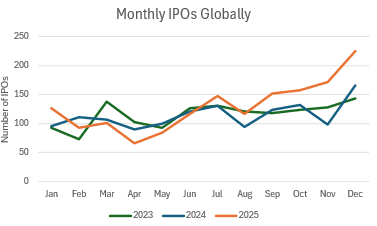
The reasons behind this seasonal behaviour are varied. Not only companies may prefer to avoid periods when the markets tend to slow down (or example, summer months) and prefer times of higher market activity (for example, end of December); they may also have to align the timing of an IPO with the quarterly reporting cycle (March, June-July, October), for example.
In fact, if we look at longer period, and consider the average number of listings per month, we can see that these patterns are very persistent (Figure 2).
Figure 2:
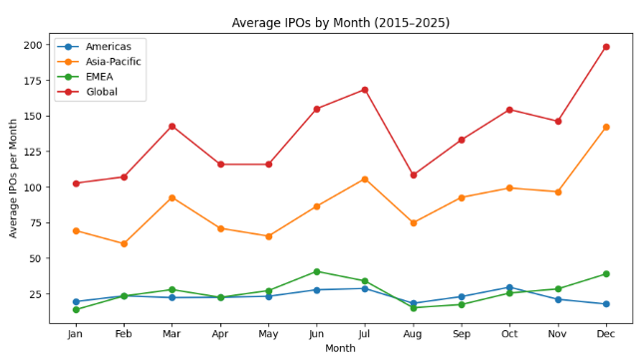
But the plot also suggests that the intensity of these patterns may not be the same across regions. To explore this further, in Figure 3 we split the 2023-2025 comparison by region:
Figure 3:
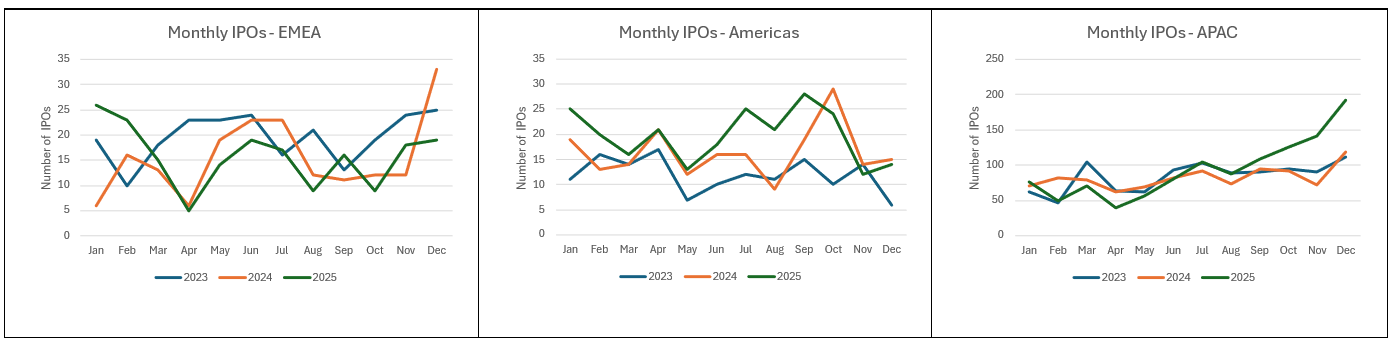
We see that in APAC the coincidence of seasonal pattern across years is very strong, with the monthly number of IPOs showing annual auto correlations between 63% and 77%. In the Americas region, the coincidence is less pronounced, especially in the second half of the year. And the EMEA region does not seem to follow the same seasonal pattern across years. In fact, 2025 is negatively correlated with 2023.
The results suggest that, when looking at seasonality at global level, the fact that APAC has the largest number of listings may conceal the existence of regional variation in seasonal patterns, and that these variations can be significant.