Making Sustainability Investable by Driving Competitiveness: The Role of Exchanges
Exchanges are first and foremost market infrastructure providers. Their core role is to support capital formation and allocation, fair and orderly trading, efficient price formation, liquidity, reliable market data, issuer access, investor protection, regulatory confidence and systemic risk reduction.
Sustainability is highly relevant to exchanges where it strengthens these functions, for example by improving transparency, comparability, risk assessment and confidence in capital allocation.
This distinction matters. Sustainability should not be framed as a standalone virtue that markets will automatically reward, or as a substitute for the commercial and regulatory foundations of exchange activity. Instead, sustainability-related information, standards, products and classifications can improve market quality when they help investors and lenders assess financial risks and opportunities more effectively.
Making sustainability investable requires a robust business case for exchanges as well as quoted companies. These issuers need to show how sustainability affects cash flows, the cost of capital, resilience, regulatory exposure, competitiveness and long-term value. Exchanges should apply the same discipline to their own sustainability initiatives, demonstrating how they improve market confidence, issuer and investor demand, data and product offerings, regulatory readiness, greenwashing risk management and trust in regulated public markets.
The WFE's own Sustainability Survey shows exchanges moving beyond advocacy into practical market tools, including sustainable finance data platforms, issuer disclosure tools, carbon management solutions, sustainability indices, green and transition designations, carbon marketplaces and dedicated sustainability listing segments. Examples include Shenzhen Stock Exchange's Sustainable Finance Service Zone, JPX's disclosure tools, SIX's climate data services, SET's carbon management tool, HKEX's Core Climate marketplace and JSE's Sustainability Segment.
Market-level data suggests progress in issuer disclosure and performance, while remaining uneven. Euronext's 2025 ESG Trends Report, covering more than 1,550 listed companies, found reductions in Scope 1 and 2 emissions among consistent reporters, alongside increases in Scope 3 and energy-related disclosure.
Again referencing the WFE Sustainability Survey, the evidence points in the same direction: 50 respondents reported that listed companies are encouraged or required to disclose sustainability information; 17 exchanges require such disclosure; 71 percent provide guidance on material sustainability issues; and 90 percent expressed support for the International Sustainability Standards Board (ISSB).
These examples do not prove that markets consistently reward sustainability, but they show exchanges helping to create more comparable, decision-useful information to support capital allocation.
This activity reflects a combination of drivers: investor demand, regulatory change, stakeholder expectations, reputational considerations, sustainability concerns and commercial opportunities in product development, data services and listings. That mix of motivations should not be seen as a weakness. It is how market infrastructure evolves. The key question is whether these incentives are channelled into practices that strengthen the integrity, usefulness and commercial relevance of public markets.
This aligns closely with WBCSD's strategic objective of making sustainability investable.
WBCSD aims to support exchanges by helping issuers translate sustainability performance into the financial evidence mentioned above that investors and lenders can use: impacts on cash flows, the cost of capital, resilience, regulatory exposure, competitiveness and long-term value creation. For exchanges, the opportunity is to build the market infrastructure through disclosure guidance, data, classifications, products and dialogue that makes this information more trusted, comparable and relevant to financing decisions.
We have set the scene on the "what". It is now time to drill down into the "how".
WBCSD works with exchanges to advance trust, comparability and relevance by helping issuers, investors and market operators build the evidence, tools and dialogue needed to translate sustainability performance into investability, long-term resilience and value creation. Specifically, we focus on the following areas:
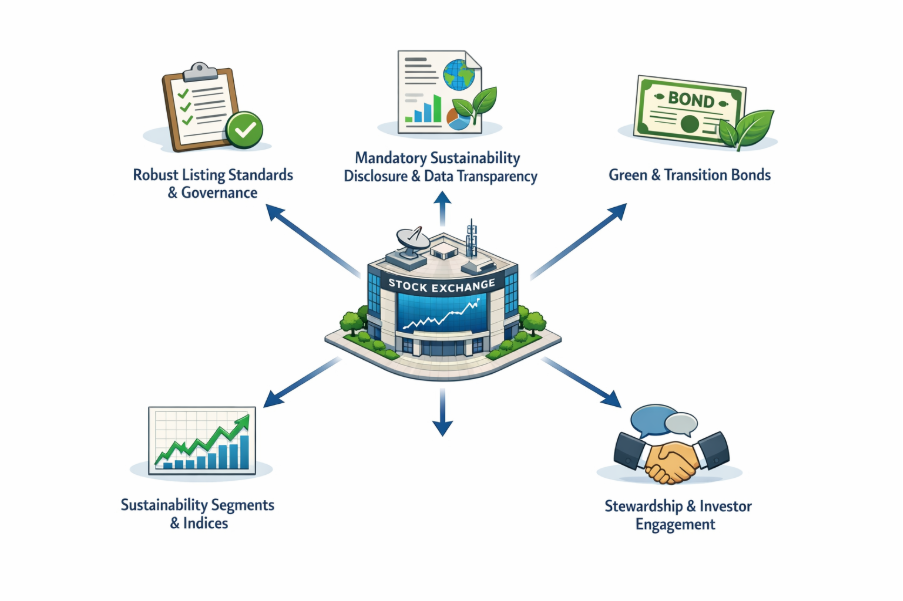
Figure 1: An exchange-centric ecosystem: Stock exchanges can leverage listing standards, disclosure regimes, sustainable finance segments, indices and stewardship initiatives to support companies in pursuing long-term sustainability strategies.
1. Market quality is a competitive asset.
Trust is the foundation of investable markets. Investors are more likely to back companies through multi-year transitions when they have confidence in market integrity, shareholder rights, governance standards and reliable reporting. For WFE members, peer-market experience shows that governance quality is not a compliance burden but a competitive feature of public markets. B3's Novo Mercado and governance reforms linked to the Tokyo Stock Exchange's Prime Market illustrate how stronger standards can reinforce investor confidence and attract more durable institutional capital. Lowering standards to compete for listings may win issuers in the short term, but it risks eroding the credibility on which public markets depend.
2. Disclosure transforms sustainability ambition into market-relevant information.
Investors cannot allocate capital efficiently without consistent, decision-useful information. Exchanges play a critical role in helping issuers translate sustainability strategies, risks and opportunities into disclosures that support market confidence, transparency and effective price formation.
As sustainability reporting requirements continue to expand across jurisdictions, many issuers face increasing costs and complexity from overlapping disclosure obligations. WBCSD aligns with the WFE's call for a pragmatic "report once, use many" approach, enabling companies to leverage the same sustainability data, systems and reporting processes across multiple reporting regimes where disclosure objectives are substantially aligned. Mechanisms such as recognition, deference and passporting can help reduce unnecessary duplication while preserving transparency and investor protection.
For exchanges, this presents an opportunity to champion greater interoperability, improve data comparability and support continued access to global pools of capital. Alignment around internationally recognised standards, including IFRS S1 and IFRS S2, can further strengthen consistency across markets, allowing issuers to focus on producing high-quality, reliable disclosures that help investors assess resilience, transition readiness and long-term value creation.
3. Sustainable finance needs credible market signals.
Exchanges can make sustainability easier to find, compare and finance. Green economy labels, transition designations, sustainability indices and dedicated bond segments help issuers signal whether their activities, financing or transition plans meet defined criteria. The WFE's Green Equity Principles and draft Transition Equity Principles matter because they give exchanges a shared basis for designing credible, comparable designations across markets.
Peer examples such as the London Stock Exchange's Green Economy Mark and B3's Green Equity designation show how these tools can increase visibility and investor reach, provided they are backed by clear eligibility criteria, external review and transparent reporting.
4. Market design can make long-term performance more visible.
Exchanges influence not only what is listed, but how markets engage with listed companies. By promoting stewardship, issuer-investor dialogue, better ESG data and sustainability indices, they can shift attention from short-term price movements to the drivers of durable value.
This matters because sustainability is increasingly connected to competitive advantage: companies that manage material ESG risks and opportunities well are better placed to protect margins, strengthen resilience, reduce financing risk and capture growth opportunities. Recent ESG performance trends point in the same direction: stronger ESG profiles are associated with more stable revenues and cash flows; governance quality is linked to profitability; and issuer disclosure on emissions, energy use and transition targets is becoming more robust.
Coordination with regulators can further reduce unnecessary short-term pressures and support more consistent sustainability reporting. As exchanges develop data platforms and products, they can make transition performance more visible, comparable and financially relevant.
Conclusion and takeaways
Exchanges are not becoming sustainability institutions; they remain market infrastructure providers. Their opportunity is to ensure that sustainability-related information, standards and products strengthen the core functions of markets: transparency, investor confidence, efficient capital allocation and risk management.
For WFE members, this is a practical agenda: improve decision-useful disclosure, support credible classifications, build reliable data and product infrastructure, and reduce fragmentation across reporting regimes. Done well, these actions can help issuers explain how sustainability connects to financial fundamentals and help investors distinguish credible performance from weak claims.
WBCSD stands ready to partner with exchanges to advance this agenda. The goal is not to claim that sustainability is automatically priced or rewarded, but to make financially material sustainability performance more visible, trusted, comparable and relevant to capital allocation.
Key takeaways
- Keep the market infrastructure role clear: Sustainability matters where it strengthens transparency, price formation, issuer access, investor protection and confidence in public markets.
- Make sustainability investable through evidence: Companies need to connect sustainability performance to cash flows, the cost of capital, resilience, competitiveness and long-term value.
- Apply the same business-case discipline to exchanges: Exchanges' sustainability initiatives should aim to strengthen market confidence, data quality, product credibility, issuer engagement and regulatory readiness.
- Build credible market signals: Disclosure guidance, sustainability data, green and transition classifications, indices and listing segments can help investors distinguish credible strategies from weak claims.
- Avoid overclaiming market rewards: The objective is not to assert that sustainability is consistently priced today, but to improve the conditions under which financially material sustainability performance can inform capital allocation.
Disclaimer:
The views, thoughts and opinions contained in this Focus article belong solely to the author and do not necessarily reflect the WFE’s policy position on the issue, or the WFE’s views or opinions.